

What Is Disaster Preparedness for Residents with Foreign Roots? Explaining Community Support and Preparation for Disasters
Disasters such as earthquakes, typhoons, heavy rain, and fires can happen anywhere and at any time. When residents with foreign roots live in the community, some people may wonder how they should reach out to them and what kind of support they can provide in times of disaster. Some foreign residents may have difficulty understanding disaster information in Japanese or may be unfamiliar with evacuation shelter locations and Japan’s disaster preparedness systems.
What is important is not to assume that someone is having difficulty simply because they are a foreigner, but to reach out to one another as residents living in the same community and share necessary information.
In this article, we explain the challenges that residents with foreign roots may face during disasters, disaster preparedness initiatives being carried out in various communities, and ways local communities can provide support.
目次
- 1 Let’s Start Disaster Preparedness with Residents with Foreign Roots in Our Community
- 2 Challenges That Residents with Foreign Roots May Face During Disasters
- 3 What Communities Across Japan Are Doing for Disaster Preparedness for Foreign Residents
- 4 Why Is “Easy Japanese” Receiving Attention in Disaster Preparedness?
- 5 How Should We Interact with Residents with Foreign Roots During a Disaster?
- 6 Disaster Preparedness Initiatives with Residents with Foreign Roots That Can Be Started During Normal Times
- 7 Why Not Think About Multicultural Coexistence Through Disaster Preparedness?
- 8 Kyotamba Town Is Promoting Multicultural Coexistence
- 9 Summary
Let’s Start Disaster Preparedness with Residents with Foreign Roots in Our Community
Japan is a country where natural disasters such as earthquakes, typhoons, and heavy rain occur frequently. In recent years, the number of residents with foreign roots living in local communities has also increased. During disasters, however, necessary information may not reach them because of differences in language, culture, and lifestyle. That is why disaster preparedness should not be considered something only Japanese residents need to think about. It is important for everyone living in the same community to work on it together.
Building relationships where people know one another and sharing information about evacuation sites and ways to contact each other in everyday life can provide reassurance when a disaster occurs.
The Importance of “Disaster Preparedness That Leaves No One Behind”
During a disaster, residents with foreign roots may have concerns such as the following.
- They may have difficulty reading evacuation information written in Japanese
- They may not know where they should go
- They may find it difficult to ask people around them for help
The reason they may have difficulties is not simply because they are “foreigners,” but because they may lack access to information and connections with people around them.
There are many things we can do in our communities, such as speaking to people using Easy Japanese, going with them to an evacuation shelter, and inviting them to disaster preparedness drills. Having a willingness to help one another as residents of the same community, without making assumptions based on preconceived ideas, leads to “disaster preparedness that leaves no one behind.”
Challenges That Residents with Foreign Roots May Face During Disasters
When a disaster occurs, residents with foreign roots may face difficulties that are different from those faced by Japanese residents.
- Disaster information may be difficult to understand
- They may not know where evacuation shelters are or how to evacuate
- They may be unfamiliar with Japan’s disaster preparedness systems
- They may not have Japanese residents around them whom they can ask for advice
- They may be more vulnerable to rumors and misinformation
Here, we explain the challenges they may commonly face.
Difficulty Understanding Disaster Information
When an earthquake, heavy rain, fire, or other disaster occurs, information such as evacuation orders, warnings, and the opening of evacuation shelters is issued within a short period of time. However, Japanese technical terms and expressions commonly used by government authorities can be difficult for residents with foreign roots to understand, making it difficult for them to immediately grasp the situation.
Terms such as “Evacuation of the Elderly, etc.” and “Ensuring Emergency Safety” may be difficult to understand and may cause confusion even among people who are accustomed to Japanese.
Not Knowing Where or How to Evacuate
Some residents with foreign roots may not know where they should evacuate during a disaster or which routes are safe to take.
People who have recently come to Japan or who have little connection with the local community may not know the location of the nearest evacuation shelter, what they should take with them when evacuating, or how to register at an evacuation shelter. In addition, some people may come from countries where going to evacuation shelters is not a common practice, making it difficult for them to understand why they need to evacuate.
Being Unfamiliar with Japan’s Disaster Preparedness Systems
In Japan, local governments provide disaster information, open evacuation shelters, and work together with community-based disaster preparedness organizations, volunteer fire corps, and others to respond to disasters. However, some residents with foreign roots may have few opportunities to learn about these systems and may not know that they can ask the local government or community for help during a disaster.
They may also be unaware that water and food are distributed at evacuation shelters or that procedures such as obtaining a disaster victim certificate are available.
Having No Japanese Residents Around Them to Consult
Even when living in a local community, some residents with foreign roots may have little contact with their neighbors because of work or family circumstances and may have no one to consult with in times of disaster. In particular, people who are not confident in Japanese may find it difficult to ask for help themselves, even when they are having trouble.
Simply greeting neighbors on a regular basis or inviting them to local events and disaster preparedness drills can help build relationships in which people know one another. Support during disasters does not require special knowledge. Being able to say, “Are you okay?” or “Let’s go together” can make a difference and may help protect lives.
Being More Vulnerable to Rumors and Misinformation
During disasters, uncertain information can spread through social media and word of mouth. Residents with foreign roots may have difficulty accessing accurate information in Japanese and may sometimes believe incorrect information circulating within communities that share their native language.
For example, if incorrect information is shared about the location of evacuation shelters, the distribution of relief supplies, or the extent of disaster damage, appropriate action may be delayed. In local communities, it is important to direct people to reliable sources of information, such as local governments, fire departments, and the Japan Meteorological Agency, and to check information together.
What Communities Across Japan Are Doing for Disaster Preparedness for Foreign Residents
Local governments and international exchange associations in various parts of Japan are working to create communities where foreign residents can live with peace of mind by improving how disaster information is communicated and how disaster preparedness drills are conducted.
Here, we introduce actual disaster preparedness initiatives being carried out for foreign residents.
Providing Disaster Information in Multiple Languages
During a disaster, receiving accurate information quickly can help people take actions that protect their lives. For this reason, communities across Japan are increasingly providing disaster information in languages spoken by foreign residents living in the area, such as English, Chinese, Vietnamese, and Portuguese.
Examples include translating disaster maps, evacuation shelter information, and pamphlets explaining what to do during disasters into multiple languages, as well as providing multilingual information through local government websites, social media, and disaster preparedness apps. As local residents, simply paying attention to whether foreign-rooted neighbors are able to access the information they need can also be a form of support.
Using “Easy Japanese”
Multilingual support is important, but it is not always easy to immediately provide information in every language. This is why “Easy Japanese” is being used in many communities.
“Easy Japanese” refers to Japanese that avoids difficult words and communicates information using short and easy-to-understand expressions.
For example, instead of simply saying, “Please evacuate,” saying, “It is dangerous. Please go to a safe place now” makes the meaning easier to understand.
During disasters, it is also helpful to avoid technical terms and ambiguous expressions, speak slowly, write information down on paper, and use pictures and maps. It is important to be aware of Easy Japanese in everyday life as a way of supporting everyone in the community.
For more information about “What is "Easy Japanese"? Learn How to Use It to Support Multicultural Coexistence” please see the following article.
Conducting Disaster Preparedness Drills for Foreign Residents
To help foreign residents act calmly during disasters, local governments and international exchange associations conduct disaster preparedness drills and lectures. By actually experiencing how to use evacuation shelters, what to include in emergency supplies, and how to communicate with others during disasters, participants can more easily turn their knowledge into action.
The Kyotanba Town International Exchange Association planned “Let’s Prepare for Disasters Together! Disaster Preparedness Sports Day,” where foreign and Japanese residents can learn about disaster preparedness while moving their bodies together. is organizing These kinds of activities are also useful for viewing disaster preparedness not as something difficult for foreign residents, but as an opportunity for interaction within the local community.
Let’s Prepare for Disasters Together! “Disaster Preparedness Sports Day”
Multilingual Support in the Operation of Evacuation Shelters
At evacuation shelters, where many people gather during a disaster, measures are needed to ensure that necessary information reaches foreign residents as well.
At reception areas and on signs, it can be effective to use not only multilingual displays but also pictograms (pictures and symbols designed to communicate information and warnings intuitively) and maps to provide visual information. At evacuation shelters, consideration may also be needed for food, lifestyle practices, and religious requirements, so it is important to create an atmosphere where people feel comfortable discussing their concerns.
Regardless of their background, when local residents communicate with one another and share information as “fellow evacuees,” it can lead to the operation of evacuation shelters where everyone can stay with peace of mind.
Distributing Disaster Preparedness Handbooks
For disaster preparedness for foreign residents, it is important to provide information during normal times, before a disaster occurs.
Across Japan, communities are providing multilingual disaster preparedness handbooks that summarize what to do in the event of an earthquake, typhoon, or heavy rain, as well as the locations of evacuation shelters, emergency supplies to take with you, emergency contact information, and more. In addition to printed booklets, information available for download from local government websites and information that can be checked on smartphones can also be useful. Rather than simply handing out a handbook, reviewing its contents together at local disaster preparedness drills, Japanese language classes, and community exchange events makes it easier to put the information into practice.
Why Is “Easy Japanese” Receiving Attention in Disaster Preparedness?
“Easy Japanese” is Japanese that replaces difficult words with simpler expressions and communicates information in a short and easy-to-understand way. It originally spread as a form of support for foreign residents who had difficulty understanding words such as “evacuation” and “warning” during the Great Hanshin-Awaji Earthquake and therefore had difficulty taking appropriate action during the disaster.
In recent years, Easy Japanese has been used not only in disaster preparedness administration but also in tsunami warning news on television, with expressions such as “Tsunami! Run!” that encourage people to take immediate action. In situations involving human lives, what matters most is not only accuracy but also making sure the message is understood immediately.
You Can Do It Now! Ways to Make Your Words Easier to Understand During Disasters
To make information easier to understand during disasters, it is important to avoid difficult words and communicate using short, specific sentences. For example, instead of saying “Beware of aftershocks,” saying, “There may be another earthquake. Be careful of objects falling from above” makes it easier to imagine what action to take.
Adding hiragana to signs containing many kanji, using maps and pictures, and speaking slowly with gestures can also be effective. Even if you cannot make a perfect translation into Easy Japanese, trying to communicate with the other person is the first step toward providing support.
Easy to Understand for Children and Older Adults, Too
Easy Japanese is not only for foreign residents. It can also make information easier to understand for children, older adults, people with disabilities, and people who have difficulty reading Japanese text.
During a disaster, everyone becomes anxious, and even information that people would normally understand may be difficult to take in. In such situations, communicating in a short, clear, and specific way can help everyone feel more secure. Being conscious of Easy Japanese in the community not only supports foreign residents but also contributes to creating a disaster preparedness system in which everyone can act safely.
How Should We Interact with Residents with Foreign Roots During a Disaster?
When interacting with residents with foreign roots during a disaster, it is important first of all not to assume that they “must not understand because they are foreigners” or that they “must need help.”
Some people may speak Japanese well, have extensive knowledge about disaster preparedness, or have lived in the community for a long time. On the other hand, some people may feel anxious because they have not received the necessary information.
What is important is to naturally reach out to them as fellow residents of the same community, rather than treating them as someone special. Ask, “Are you okay?” or “Is there anything you need help with?” and, if necessary, check the evacuation shelter or evacuation route together. They may also be able to help you. During a disaster, it is especially important to have an awareness of helping one another beyond differences in nationality and culture.
Disaster Preparedness Initiatives with Residents with Foreign Roots That Can Be Started During Normal Times

To create a community where people can help one another during disasters, it is essential to build relationships during normal times.
Even if you try to reach out only when a disaster occurs, it may be difficult to provide appropriate support because you do not know the other person’s situation or concerns. Greeting one another regularly and participating in local events together can naturally create relationships in which people feel comfortable asking for help.
Here, we introduce disaster preparedness initiatives with people with foreign roots that can be started in everyday life.
Invite Them to Local Disaster Preparedness Drills
Local disaster preparedness drills are an important opportunity to learn where to evacuate and how the evacuation process works. However, some residents with foreign roots may not notice announcements about the drills or may hesitate to participate because they do not understand what they involve.
Simply saying, “Would you like to go together?” can make it easier for them to participate. During the drills, participants can actually learn how to use fire extinguishers, how to register at evacuation shelters, what to take with them in an emergency, and more. Learning together as local residents can also help build relationships in which people can naturally support one another during disasters.
Build Relationships Where You Know Residents with Foreign Roots Face to Face
To be able to reach out to one another during a disaster, it is important to build relationships where people know each other during normal times.
There is no need to have difficult conversations. You can start with everyday greetings and simple interactions. Rather than paying unnecessary attention to someone’s nationality or culture, it is important to interact with them as a neighbor living in the same community. Once you know each other, it becomes easier to say, “Are you okay?” or “Let’s evacuate together” during a disaster. Small connections made in everyday life can lead to reassurance and mutual support when an emergency occurs.
Check Your Local Government’s Disaster Preparedness Information
It is also important to check disaster preparedness information provided by your local government during normal times. There are various forms of information available that can be useful during a disaster, including disaster preparedness maps, lists of evacuation shelters, disaster alert emails, disaster preparedness apps, and multilingual information pages.
It is reassuring for local residents to know where residents with foreign roots can find the information they need. Checking evacuation sites, contact information, and consultation services for times of disaster together can help reduce confusion when an emergency occurs.
Participate in Local International Exchange Events
Building relationships with residents with foreign roots does not have to begin in a setting specifically focused on disaster preparedness. Participating in local international exchange events, cultural experience activities, cooking classes, seasonal events, and other activities can create opportunities for natural communication. Getting to know one another while having fun can help build relationships in which people feel comfortable reaching out to each other during disasters.
Disaster preparedness is an important effort to protect lives, but its foundation is the trust built through everyday relationships. Start by participating in familiar opportunities for interaction, such as local events, and build connections as fellow residents living in the same community.
Why Not Think About Multicultural Coexistence Through Disaster Preparedness?
Disaster response is an issue that concerns all residents, regardless of nationality, culture, or language. That is why disaster preparedness can also provide an opportunity to think about multicultural coexistence.
As introduced in this article, small actions such as “greeting one another regularly,” “participating in disaster preparedness drills together,” and “sharing information about evacuation shelters” can build relationships in which people can help one another during disasters. Why not start creating a community where everyone can live with peace of mind through disaster preparedness?
Kyotamba Town Is Promoting Multicultural Coexistence
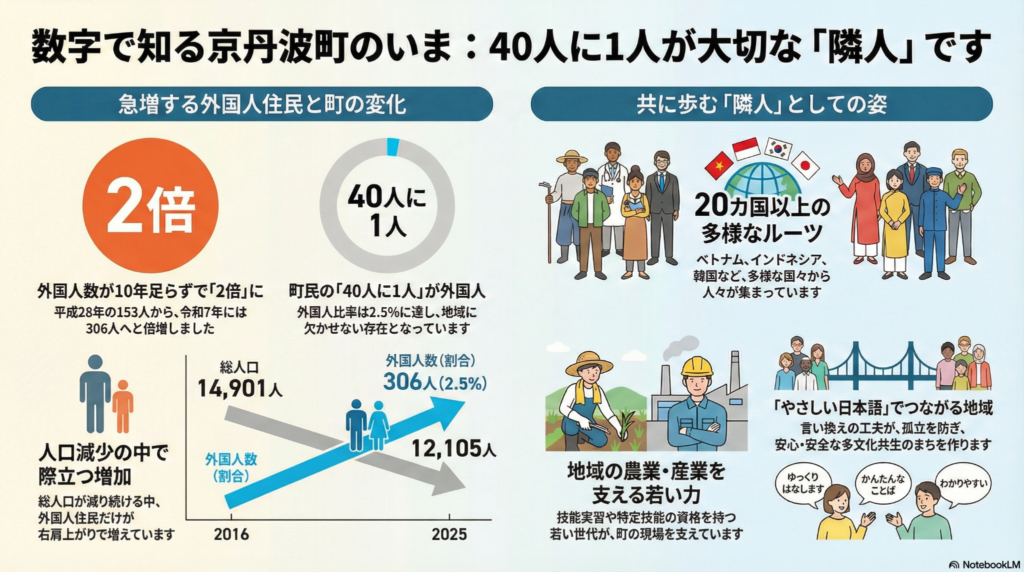
Kyotanba Town is working to create a multicultural community where residents with foreign roots and Japanese residents living in the community can understand one another and live with peace of mind.
The Kyotanba Town International Exchange Association supports the creation of connections that transcend differences in nationality and culture through exchange events and the dissemination of information.
Disaster preparedness is one of these important themes. To help one another during disasters, it is essential to build relationships where people know each other and share necessary information during normal times.
First, participate in local events and disaster preparedness activities, and start expanding connections in ways that are possible for you, as fellow residents living in the same community.
For more information, please visit our official website.
Kyotaba Town International Exchange Association – Official Website
Summary
For disaster preparedness for residents with foreign roots, it is important to prepare during normal times through multilingual information, the use of Easy Japanese, and encouraging participation in disaster preparedness drills. During a disaster, challenges may arise, such as difficulty understanding evacuation information, not knowing where or how to evacuate, and having no one nearby to consult.
There are things we can do in our communities during normal times, rather than relying only on special support. Getting to know one another through greetings and everyday conversations, reaching out to others, checking evacuation sites together, and inviting people to disaster preparedness drills and local events are all small everyday actions that can lead to mutual support during disasters.
Disaster preparedness is an important theme that concerns all residents, regardless of nationality, culture, or language. Strengthening connections among people as fellow residents of the same community can become a powerful force for overcoming disasters.
関連記事
-
What is a Local Japanese Language Class? From Learning Content to Volunteer Opportunities
A local Japanese language class is a space where residents with foreign roots learn Japanese and essential daily life information. This article explains the differences from private language schools, learning materials, attendee backgrounds, and how to participate as a volunteer.
-

Introducing 10 Case Studies of Multicultural Coexistence Initiatives
Discover 10 real-world examples of multicultural coexistence, from language support and disaster preparedness to healthcare and local exchange. Also introduces initiatives in Kyotamba, Kyoto.
-
What is "Easy Japanese"? Learn How to Use It to Support Multicultural Coexistence
An easy-to-understand guide to "Easy Japanese" (Yasashii Nihongo). Discover its origins, practical use cases, relationship with multicultural coexistence, and key writing tips. Learn how anyone can practice and integrate Easy Japanese into daily life.

Click here for our other SNS
-
Facebook

-
X

-
LINE

-
Youtube