


Why Is Multicultural Coexistence Important?

As Japan faces a declining birth rate, an ageing population, and a growing number of foreign-born workers, multicultural coexistence is becoming increasingly important. Creating communities where people from different backgrounds can live and support one another brings many social and economic benefits.
In this article, we explore why multicultural coexistence matters, introduce initiatives in Kyoto Prefecture, and share practical actions that can be taken at the local level.
目次
- 1 What Is Multicultural Coexistence?
- 2 Why Is Multicultural Coexistence Necessary in Japan? Four Key Perspectives
- 3 The Benefits of Multicultural Coexistence for Local Communitie
- 4 Challenges facing multicultural coexistence
- 5 What happens if multicultural coexistence does not progress?
- 6 We support multicultural coexistence in Kyotamba Town
- 7 Summary
What Is Multicultural Coexistence?
Multicultural coexistence means creating communities where people of different nationalities, ethnic backgrounds, languages, religions, and values can live together while respecting one another.
In this context, “coexistence” does not mean “assimilation.” It is not about people of foreign origin adapting completely to Japanese culture. Rather, it means creating a society where everyone can live with peace of mind while valuing their own cultures and backgrounds. The foundation of multicultural coexistence is not removing differences, but recognizing them and supporting one another.
The concept of “respecting” differences in nationality and culture
Multicultural coexistence does not seek to erase differences in nationality or culture. Instead, it encourages people to understand and respect differences in food, religion, language, values, and daily life through ongoing dialogue.
Practical efforts such as multilingual public services and Japanese language learning support are important steps in this process. Rather than seeing differences as problems to solve, embracing diversity as something that enriches our communities helps create a society where everyone can live with peace of mind.
Background of its adoption in Japan
The growing use of the term “multicultural coexistence” in Japan reflects the increasing number of people with foreign roots living and working in the country.
According to the Ministry of Health, Labour and Welfare, the number of foreign workers in Japan reached 2,302,587 at the end of October 2024, up 12.4% from the previous year. As Japan faces a declining birth rate, an ageing population, and labour shortages, foreign residents play an increasingly important role in supporting local economies. At the same time, differences in language and social systems have created new challenges, highlighting the need to build communities where everyone can live together comfortably.
Source:Employment of Foreign Nationals” Reports (as of the end of October 2024) | Ministry of Health, Labour and Welfare
Gunma prefecture enacts ordinance to promote multicultural coexistence
In Gunma Prefecture, where the proportion of residents with foreign roots is especially high, an ordinance to promote multicultural coexistence has been enacted, leading to initiatives across the prefecture. Based on this ordinance, systems are being developed to strengthen Japanese language education, provide consultation services, and encourage community exchange.
In the Kansai region, Kobe City introduced the Kobe City Ordinance on the Elimination of Unjust Discrimination Against Foreign Nationals and the Realization of a Multicultural Coexistence Society in 2024.
These examples show that multicultural coexistence is no longer an issue limited to certain areas, but a nationwide priority across Japan.
Source:Gunma Prefecture Multicultural Coexistence and Co-creation Promotion Ordinance
Kobe City Ordinance Concerning the Elimination of Unjust Discrimination Against Foreign Nationals and the Realization of a Multicultural Coexistence Society
Why Is Multicultural Coexistence Necessary in Japan?
Four Key Perspectives
The need for multicultural coexistence in Japan is growing as the country undergoes major social changes. Declining birth rates, an ageing population, and overall population decline are creating serious challenges. As the workforce shrinks, it is becoming harder to sustain local communities. Multicultural coexistence is no longer just an ideal—it is a practical solution for the future of local areas.
Below, we explore why it is necessary from four key perspectives.
Declining birth rates and an ageing population are reducing community supporters
Japan’s declining birth rate and ageing population are major reasons why multicultural coexistence is becoming increasingly important. As the working-age population continues to shrink, the number of people available to support the workforce is rapidly decreasing.
This can lead to serious challenges, such as:
- Essential services like nursing care, healthcare, and logistics becoming harder to maintain
- Local infrastructure such as transportation, shops, and public services weakening
In many industries, labour shortages are already making it difficult to continue operations. For municipalities across Japan, securing enough workers to sustain local communities has become an urgent issue.
The shift toward a society where people with foreign roots participate in every aspect of Life
It is important to recognise that the time when people with foreign roots play a central role in local communities is not something in the future—it has already begun.
Many people with foreign roots now work in places closely connected to our daily lives, such as convenience stores, factories, care facilities, and farms. It is also increasingly common to see children and families with foreign roots taking part in schools and community events.
Multicultural coexistence is not simply preparation for the future—it is already essential for the smooth running of local communities today.
Preventing trouble through multicultural coexistence
As multicultural coexistence becomes more common and diversity is embraced, many problems can be prevented before they arise.
When people have different languages and cultural backgrounds, small misunderstandings can grow into anxiety if there is not enough communication and understanding. Over time, this can create divisions between “locals” and “newcomers.”
The aim of multicultural coexistence is not to force people to get along, but to create communities where everyone can live with peace of mind by understanding each other’s rules, customs, and backgrounds. Clear information sharing and open dialogue are key to preventing local problems before they happen.
Preparing for emergencies such as disasters, medical situations, and childcare
Multicultural coexistence is also vital because it helps communities support one another in times of need. During disasters or disease outbreaks, ensuring that accurate information reaches everyone can be a matter of life and death.
If evacuation notices or medical guidance are available only in Japanese, some people may be unable to access the support they need. In addition, difficulties understanding systems such as childcare services or vaccinations can increase anxiety and isolation.
Multicultural coexistence is not only about everyday interaction—it is also about creating systems that ensure no one is left behind during emergencies.
Promoting globalization as a region
Multicultural coexistence encourages the acceptance of people with foreign roots and collaboration with diverse talent. As a result, it becomes a driving force for regional globalization and internationalization.
Communities that embrace multiculturalism are better able to adapt flexibly in a rapidly changing world. This strength can also support international business, tourism, and talent attraction, helping to revitalize local areas.
Multicultural coexistence is not simply a welfare measure—it is an important foundation for sustainable regional development.
The Benefits of Multicultural Coexistence for Local Communitie
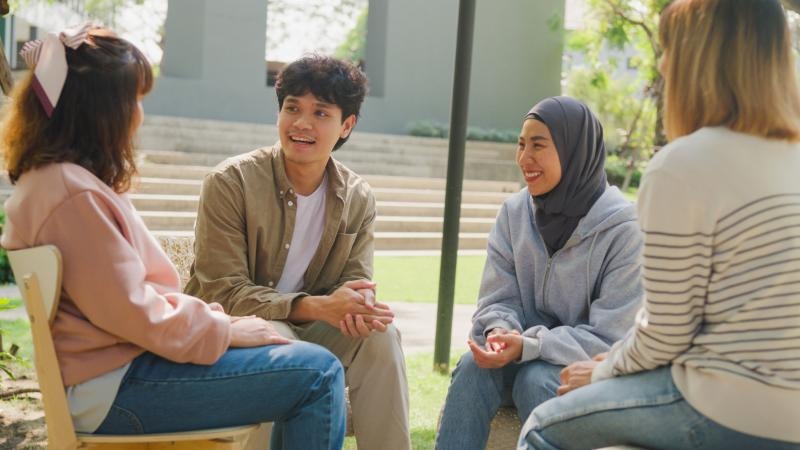
Multicultural coexistence benefits not only people with foreign roots, but everyone in the community.
Key benefits include:
- Creating stable communities where people can live with peace of mind
- Making society more comfortable and inclusive for Japanese residents as well
- Bringing in new cultures and perspectives
Let’s take a closer look at each of these points.。
Creating stable communities where people can live with peace of mind
As multicultural coexistence advances, misunderstandings and prejudice within communities begin to decrease, helping to create a society where everyone can live with greater peace of mind.
By putting support systems in place that take into account language barriers and differences in social systems, fewer people are left feeling uncertain, and a stronger sense of security is built across the community.
When people can understand and respect each other’s perspectives, this has a positive impact in many areas, including disaster preparedness, childcare, and healthcare. In turn, it leads to more stable, inclusive, and livable communities for everyone.
Creating a society that Is comfortable for Japanese residents as well
Multicultural coexistence is not only for people with foreign roots. Efforts such as using "Easy Japanese", sharing information in clear and accessible ways, and strengthening consultation services are also helpful for older adults, children, and people with disabilities.
Systems designed with diverse needs in mind make communities easier for everyone to navigate and use. As a result, they help create more inclusive communities that are comfortable to live in for Japanese residents as well.
New cultures and ways of thinking are introduced
When different cultures and values come together through multicultural coexistence, they bring fresh perspectives and new ideas to local communities. This is one of its greatest benefits.
Cultural exchange through food, music, and community events can add energy and vibrancy to a region, while also creating opportunities to rediscover its unique strengths.
In the workplace as well, diverse ways of thinking can lead to more flexible ideas and innovative approaches.
Multicultural coexistence expands the potential of communities and provides a strong foundation for future growth.
Challenges facing multicultural coexistence
Multicultural coexistence also brings certain challenges.
One key challenge is the communication barrier caused by differences in language and culture. Variations in daily habits and values can also lead to misunderstandings.
In addition, establishing multilingual support, Japanese language education, and consultation services requires time, resources, and skilled personnel.
However, these challenges can be addressed through ongoing dialogue and thoughtful system design. Although they may involve short-term effort, such initiatives ultimately contribute to stronger, more vibrant, and sustainable communities.
What happens if multicultural coexistence does not progress?
If multicultural coexistence does not progress, misunderstandings stemming from language and cultural differences will remain unresolved, and anxiety and distrust toward people of foreign origin may spread. There is also concern that a lack of understanding could lead to prejudice and result in more people becoming isolated.
If divisions arise within the community, it could have a negative impact on disaster preparedness, child-rearing, and community activities. Without opportunities to understand one another, we cannot build a society where everyone can live with peace of mind.
The current state of multiculturalism in Kyoto prefecture
In Kyoto Prefecture, 82,584 residents have foreign roots out of a total population of 2,517,744—meaning roughly one in every 31 residents is a foreign national (as of December 31, 2024).
These figures highlight that Kyoto is home to a diverse population, not only as a tourist destination but also as a hub for education, research, and business.
The prefecture is actively promoting advanced multicultural coexistence initiatives, with community-wide efforts continuing to grow. In Kyotamba Town as well, multiculturalism is no longer a distant idea—it is a reality in our everyday lives.
Source:Kyoto Prefecture's Initiatives for Multicultural Coexistence
You can start multicultural coexistence without doing anything special !
Multicultural coexistence does not require special qualifications or large-scale initiatives.
・Speak slowly and clearly
・Listen attentively without dismissing the other person’s culture or customs
・Invite them to participate in local events
You can start with simple actions like these.
What matters most is not shying away from differences, but having an open mind to understand them. When each person’s small efforts come together, they help build a community where everyone can live with peace of mind.
If you’d like to learn more about what you can do to promote multicultural coexistence, please also check out the following article.
What Can You Do for Multicultural Coexistence? Practical Local Examples
We support multicultural coexistence in Kyotamba Town
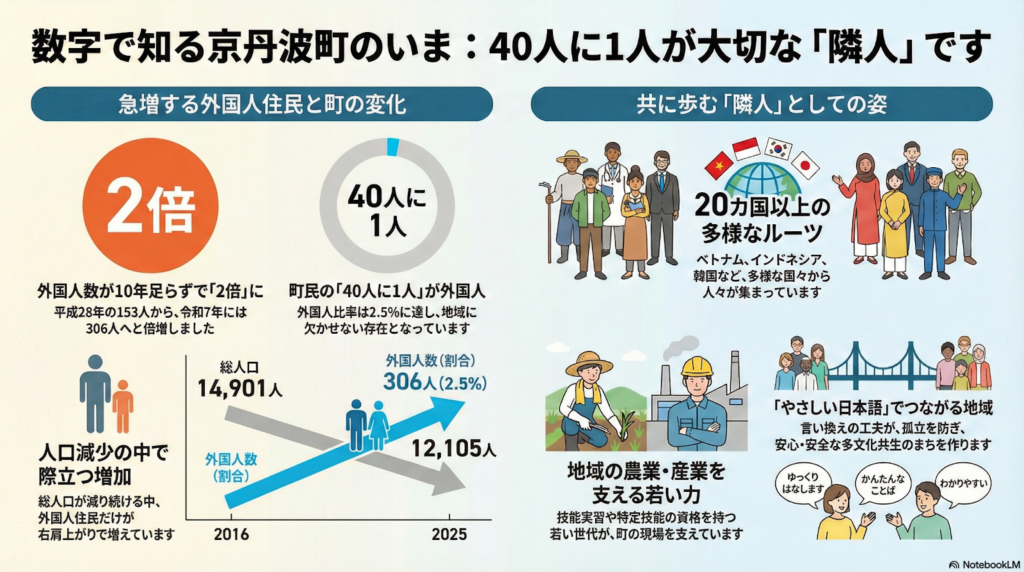
In Kyotamba Town, which has a population of 12,105, there were 306 residents with foreign roots as of December 2025—approximately one in every 40 residents.
Among them, the largest group is Vietnamese, followed by Indonesian and Korean residents. Many are technical interns or participants in the Specified Skilled Worker program, playing an important role in supporting the town’s agriculture and local industries.
The number of residents with foreign roots in Kyotamba Town continues to grow each year. They are now an essential part of the community, living and working alongside local residents in workplaces, schools, and community activities.
Kyotamba International Exchange Association serves as a bridge between residents with foreign roots and the local Japanese community.
Through community events, Japanese language support, and the sharing of practical information, we are working to create an environment where everyone can live with peace of mind.
To learn more about our activities and initiatives that support multicultural coexistence at the local level, please visit our official website.
Kyotanba International Exchange Association – Official Website
Summary
Multicultural coexistence is not just an ideal—it is essential for sustaining our communities into the future. As Japan faces a declining birth rate, an ageing population, and growing labour shortages, living alongside people with foreign roots has already become part of everyday life. While challenges remain, they can be addressed through dialogue and well-designed support systems.
What matters is not eliminating differences, but creating a community where everyone can live with peace of mind despite them. Each person’s understanding and small, thoughtful actions will help shape a more inclusive and sustainable future.
関連記事
-

Introducing 10 Case Studies of Multicultural Coexistence Initiatives
Discover 10 real-world examples of multicultural coexistence, from language support and disaster preparedness to healthcare and local exchange. Also introduces initiatives in Kyotamba, Kyoto.
-

An Introduction to Diversity: Understanding It Through Everyday Examples
An easy-to-understand introduction to diversity through everyday examples in our communities, schools, workplaces, and daily lives. Learn about its connection to multicultural coexistence and how we can build a society where everyone can live comfortably.
-

What is Cross-Cultural Understanding? Exploring Its Importance, Practical Examples, and How to Learn
An easy-to-understand guide to cross-cultural understanding. Explore its necessity, relatable examples, and practical approaches to learn mindsets that foster multicultural coexistence.

Click here for our other SNS
-
Facebook

-
X

-
LINE

-
Youtube