


What is Cross-Cultural Understanding? Exploring Its Importance, Practical Examples, and How to Learn

In recent years, opportunities to interact with foreign residents and people with diverse values have increased significantly in Japan, making "cross-cultural understanding" (Ibunka Rikai) more important than ever.
However, many people might still ask: "What does cross-cultural understanding actually involve?" or "Why is it so necessary?"
This article provides an easy-to-understand guide to the meaning and necessity of cross-cultural understanding, along with relatable examples and practical steps you can take in daily life.
目次
- 1 What is Cross-Cultural Understanding?
- 2 Why is Cross-Cultural Understanding Necessary?
- 3 Steps to Deepen Cross-Cultural Understanding
- 4 Practical Examples of Cross-Cultural Understanding
- 5 Positive Changes Brought by Cross-Cultural Understanding
- 6 Starting Multicultural Coexistence Through Cross-Cultural Understanding
- 7 Summary
What is Cross-Cultural Understanding?
Cross-cultural understanding means learning about and respecting people with cultural backgrounds, countries of origin, religions, languages, and values different from one's own.
Today, opportunities to connect with foreign residents and diverse individuals are expanding across local communities, schools, and workplaces. Fostering mutual cultural understanding within these settings is essential to building a safe, harmonious local society.
Cross-cultural understanding does not require specialized academic knowledge; it simply begins with a genuine desire to "get to know the other person."
It Does Not Mean "Eliminating Differences"
Cross-cultural understanding is not about forcing everyone to adopt the same mindset or set of values. Differences in culture and lifestyle are completely natural. What matters is recognizing those differences and maintaining an open attitude toward understanding one another.
For example, dining etiquette, communication styles, and religious practices vary widely by country and region. Rather than imposing your own "norm," adopting the perspective that "this is another valid way of thinking" creates a foundation for mutual respect.
Why is Cross-Cultural Understanding Necessary?
As the number of residents with foreign roots grows across Japan, exposure to diverse cultures in neighborhoods, schools, and offices has become part of daily life. Within this context, cross-cultural understanding is indispensable for building a society where everyone can live with peace of mind.
Here is why cross-cultural understanding is so essential:
It Serves as the Foundation for Multicultural Coexistence
Driven by globalization, local communities in Japan are entering an era where people of various origins live side by side. Beyond long-term immigrants, interactions with technical intern trainees, international students, and tourists are steadily increasing.
In this environment, cross-cultural understanding serves as a foundational pillar for "multicultural coexistence" (Tabunka Kyosei). Demonstrating an eagerness to learn about another's background helps foster a supportive, secure community.
Related Article: Why Is Multicultural Coexistence Important?
It Reduces Misunderstandings and Conflict
Without an awareness of cultural differences, minor miscommunications in speech or behavior can easily lead to friction and misunderstandings. However, as cross-cultural understanding develops, accepting "differences" becomes natural, giving rise to empathy and consideration.
Understanding daily habits and religious traditions helps prevent unnecessary conflict. Consequently, cross-cultural understanding plays a vital role in creating harmonious workplaces and neighborhoods.
Steps to Deepen Cross-Cultural Understanding

Cross-cultural understanding does not require formal overseas study or specialized training. The key is simply acknowledging that different viewpoints exist and maintaining a willing mindset.
Here are key approaches you can adopt right away:
- Start by Assuming "It is Natural to be Different"
- Experience International Cultures
- Listen Actively
- Ask Honest Questions with Respect
- Be Ready to Explain Your Own Culture
Here are key approaches you can adopt right away:
Start by Assuming "It is Natural to be Different"
The first step is accepting that others will naturally differ from you.
We often view our own cultural practices as the universal "norm." However, these standards vary widely across borders. Time perception, greeting styles, and table manners differ from culture to culture. Instead of judging something as "strange" or "wrong" based solely on your own values, ask yourself, "Why do they approach it this way?" This curiosity is the starting point of understanding.
Experience International Cultures
A great way to build awareness is by casually exposing yourself to foreign cultures in daily life.
Watching international movies, listening to global music, trying foreign cuisines, or following world news provides glimpses into different lifestyles and values. You don't need to travel abroad to encounter new perspectives—opportunities are all around us. Realizing that "your norm" is not the global standard broadens your worldview.
Listen Actively
Rather than making assumptions based on your own perspective, take the time to listen carefully to others.
Even when facing the same situation, people interpret events differently depending on their cultural background and upbringing. Asking "Why do you feel this way?" or "What is the context behind this?" deepens your comprehension. Listening attentively without rushing to judge or deny forms the foundation of trust.
Ask Honest Questions with Respect
When encountering unfamiliar customs, feeling confused is completely natural. Instead of leaving questions unanswered, asking with genuine respect often leads to deeper insights.
Approaching someone with an open "Could you teach me about this?" attitude regarding their culture or religion enriches communication. Being willing to learn matters far more than knowing everything from the start.
Be Ready to Explain Your Own Culture
Cross-cultural understanding is a two-way street; it involves reflecting on your own culture and values as well.
Attempting to explain Japanese seasonal festivals, food culture, or local customs often rekindles interest in your own heritage. Exchanging cultural insights creates richer, more balanced interactions. Being able to share your background is a crucial part of intercultural dialogue.
Practical Examples of Cross-Cultural Understanding
Occasions to encounter cultural differences in local neighborhoods, schools, and workplaces are growing. Rather than viewing these differences as obstacles, treating them as opportunities to discover new values leads to stronger relationships.
Here are concrete examples across various aspects of daily life:
Food Culture
Exploring food culture is one of the most accessible entry points into cross-cultural understanding.
Dietary restrictions, dining etiquette, and mealtimes vary significantly by country and religion. For instance, some people avoid specific ingredients due to religious beliefs. Unawareness of these practices can inadvertently cause discomfort.
Understanding the reasoning behind dietary habits enables thoughtful hospitality and demonstrates respect.
Communication Styles
Methods of communication differ across cultures. While indirect phrasing is often preferred in Japan, direct expression is valued in many other countries. Eye contact norms and the meanings of physical gestures also vary widely.
Without cultural context, directness might be misinterpreted as "rude" or "cold." Recognizing these underlying communication styles leads to smoother, more empathetic interactions.
Workstyles and Professional Values
Workplace values differ globally. In Japan, teamwork and harmony are traditionally prioritized, whereas other cultures may place greater emphasis on individual initiative and personal output. Perspectives on overtime work and taking leave also vary.
Understanding and respecting these different work philosophies prevents misunderstandings and fosters a healthier, more inclusive work environment.
School Culture
School life reflects cultural norms. Classroom participation, relationships with teachers, and event attendance vary by country. While group harmony is emphasized in Japanese schools, actively voicing individual opinions may be prioritized elsewhere.
Understanding these educational differences helps children with foreign roots feel secure at school, cultivating a classroom environment that celebrates diversity.
Religion and Traditions
Recognizing religious and traditional practices is a cornerstone of cross-cultural awareness.
Major world religions carry distinct customs, such as designated prayer times or fasting periods. Festival celebrations and holidays also differ. Honoring these practices creates an inclusive environment where everyone feels respected.
Positive Changes Brought by Cross-Cultural Understanding

Developing cross-cultural understanding brings valuable transformations to our individual lives and broader society:
- Smoother Relationships
- Broadened Perspectives
- Fresh Ideas and Innovation
- Reduced Bias and Prejudice
- Greater Acceptance of Diversity
Smoother Relationships
Accepting differences naturally reduces friction and builds interpersonal trust.
When cultures and values differ, the way words and actions are interpreted can also vary. However, maintaining an attitude that seeks to understand the other person's background makes it much easier to reduce misunderstandings and miscommunications. Furthermore, creating a reassuring sense that "it is okay to be different" makes it easier to speak openly with one another, paving the way to build relationships of trust.
Broadened Perspectives
Re-evaluating long-held assumptions encourages personal growth and open-mindedness.
It also provides an opportunity to reconsider habits and ways of thinking that you previously took for granted, leading to personal growth. For example, learning about international lifestyles and perspectives allows you to re-evaluate your own daily routines, while unlocking fresh discoveries and insights. Experiencing different cultures nurtures flexible thinking and serves as a catalyst for broadening your horizons.
Fresh Ideas and Innovation
Combining diverse viewpoints sparks creative problem-solving in workplaces and communities.
For example, incorporating diverse opinions from different perspectives—whether in the workplace or through community activities—can lead to novel initiatives. Cross-cultural understanding does not merely mean accepting differences; it acts as a powerful force for expanding new possibilities and creativity.
Reduced Bias and Prejudice
Interacting with individuals directly dispels stereotypes and fosters authentic connections.
It is natural for people to feel anxious or harbor prejudices toward things they are unfamiliar with. However, by actually taking the time to learn about another’s culture and way of thinking, it is not uncommon to find that "it wasn't what I originally pictured."
Striving to understand others through meaningful interaction enables us to see each person as an individual, which directly leads to reducing unnecessary misunderstandings and discrimination.
Greater Acceptance of Diversity
As cross-cultural understanding deepens, accepting values and lifestyles different from your own becomes second nature.
There are countless cultures and perspectives throughout the world, and there is no single "right answer." Understanding this cultivates a mindset of mutual respect rather than rejecting another's differences. In a society that embraces diversity, everyone can live comfortably and authentically. Cross-cultural understanding serves as a vital driving force that enriches our communities and society as a whole.
Crucially, the empathy developed through cross-cultural understanding improves communication not only with international residents, but among native Japanese residents as well.
Related Article: An Introduction to Diversity: Understanding It Through Everyday Examples
Starting Multicultural Coexistence Through Cross-Cultural Understanding
Cross-cultural understanding does not require overseas experience or expert training; it begins with small steps in everyday life. Cultivating a mindset of curiosity and respect toward differences is the true first step toward multicultural coexistence.
Connecting with people from diverse backgrounds brings new insights and community bonds. Why not start practicing cross-cultural understanding in your daily routine today?
For more ways to contribute to an inclusive community, explore our related articles:
What Can You Do for Multicultural Coexistence? Practical Local Examples
Supporting Multicultural Coexistence in Kyotamba Town
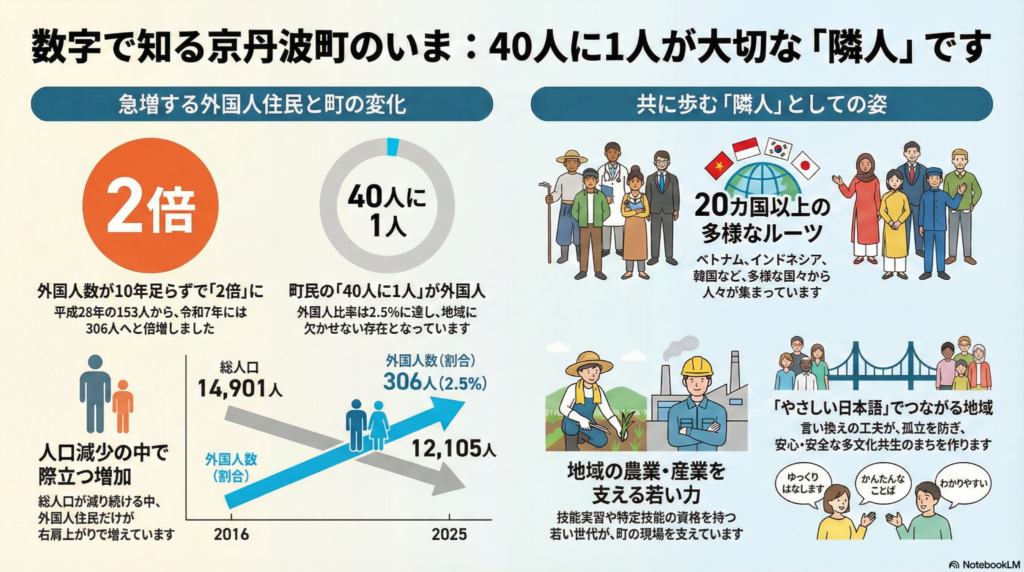
In Kyotamba Town, Kyoto Prefecture, where the total population is 12,105, there are 306 residents with foreign roots (as of December 2025). This means approximately 1 in 40 residents has an international background.
Among these 306 residents, Vietnamese nationals represent the largest group, followed by Indonesian and Korean nationals.
Kyotamba International Exchange Association undertakes diverse initiatives to ensure that international and Japanese residents can interact with confidence.
Through international exchange events, Japanese language learning support, and community disaster safety activities, the association creates opportunities to learn about different cultures and deepen mutual understanding.
Cross-cultural understanding expands through small, individual actions. If you are interested in local multicultural efforts, we warmly invite you to participate in our activities.
For more details, please visit our official website:
Kyotamba International Exchange Association Official Website
Summary
Cross-cultural understanding means learning about and respecting cultures, traditions, and values different from your own. In our increasingly globalized world, this awareness is vital across communities, schools, and workplaces.
Fostering this mindset smooths interpersonal relationships, broadens worldviews, sparks innovation, reduces prejudice, and promotes an inclusive society.
Start by adopting the perspective that "it is natural to be different," engaging with global cultures, and listening attentively to others. Small acts of understanding pave the way toward a thriving, multicultural future.
関連記事
-
What is Cross-Cultural Understanding? Exploring Its Importance, Practical Examples, and How to Learn
An easy-to-understand guide to cross-cultural understanding. Explore its necessity, relatable examples, and practical approaches to learn mindsets that foster multicultural coexistence.
-

What is "Easy Japanese"? Learn How to Use It to Support Multicultural Coexistence
An easy-to-understand guide to "Easy Japanese" (Yasashii Nihongo). Discover its origins, practical use cases, relationship with multicultural coexistence, and key writing tips. Learn how anyone can practice and integrate Easy Japanese into daily life.
-
What is a Local Japanese Language Class? From Learning Content to Volunteer Opportunities
A local Japanese language class is a space where residents with foreign roots learn Japanese and essential daily life information. This article explains the differences from private language schools, learning materials, attendee backgrounds, and how to participate as a volunteer.


Click here for our other SNS
-
Facebook

-
X

-
LINE

-
Youtube