


What Can You Do for Multicultural Coexistence? Practical Local Examples
Have you ever wanted to support multicultural coexistence in your community but weren’t sure where to start?
Multicultural coexistence isn’t something only governments or specialist organizations can promote—it grows from the everyday actions of each resident. Simple gestures like greeting a neighbor, starting a conversation, or using "Easy Japanese" (Japanese simplified for non-native speakers through careful attention to grammar and sentence length) are all meaningful steps you can take today.
In this article, we’ll explain the basics of multicultural coexistence and introduce practical actions that anyone can start right away.
目次
- 1 What is Multicultural Coexistence?
- 2 What Changes Through Multicultural Coexistence
- 3 What You Can Do for Multicultural Coexistence—Start Today
- 4 What We Can Actively Do to Promote Multicultural Harmony【Proactive action】
- 5 Ways to Support Multicultural Coexistence in Different Settings【By Role】
- 6 Frequently Asked Questions About Multicultural Coexistence
- 7 We support multicultural coexistence in Kyotamba Town
- 8 Summary
What is Multicultural Coexistence?
Multicultural coexistence refers to the idea that people with different nationalities, ethnic backgrounds, languages, religions, and values live together in the same community while respecting one another.
Its goal is not to eliminate differences, but to create a society where everyone can feel safe and comfortable despite those differences. As the number of residents with international backgrounds continues to grow in Japan, multicultural coexistence is no longer a special topic—it has become an essential perspective for sustaining local communities.
Why Multicultural Coexistence Is Needed
As Japan faces a declining birthrate, an aging population, and ongoing labor shortages, people from overseas are playing active roles across a wide range of fields. In local workplaces, schools, and in healthcare and welfare settings, it is becoming increasingly common for people with diverse backgrounds to live and work together.
At the same time, differences in language and culture can sometimes lead to misunderstandings and uncertainty. To overcome these challenges and build communities where everyone can live with a sense of safety and belonging, multicultural coexistence is more important than ever. If you would like to learn more about why multicultural coexistence matters, please see the article below:
Examples of Multicultural Coexistence Around Us
Have you ever noticed that multicultural coexistence is already part of our everyday lives?
For example, foreign restaurants in local shopping streets, multilingual signs at stations and tourist information centers, and school programs that introduce cultures from around the world are all forms of multicultural coexistence. Disaster information written in “Easy Japanese” and multilingual government services are also important systems that support it. Multiculturalism is not limited to special initiatives—it exists all around us in our daily lives. Simply becoming aware of this is the first step toward building a more inclusive community.
What Changes Through Multicultural Coexistence
As multicultural coexistence progresses, it fosters a greater sense of safety and trust within the community. When information and support systems are designed with differences in language and culture in mind, misunderstandings and anxiety can be reduced, helping to prevent potential conflicts.
Tools such as “Easy Japanese” and multilingual signage also create environments that are easier to understand not only for people with international backgrounds, but for older adults, children, and people with disabilities as well. In this way, multicultural coexistence is not just for foreign residents—it helps create communities that are more livable for everyone in Japan. Communities where everyone can feel safe and supported ultimately become more comfortable places for all residents.
What You Can Do for Multicultural Coexistence—Start Today
First, let’s look at some simple actions you can take right away to support multicultural coexistence.
| Things You Can Do Right Away | Practical Tips |
| 1.Start by Learning and Understanding | Learn About Foreign Residents in Your Area via News and Local Government Websites |
| 2.Connect with People from Diverse Backgrounds | Try Communicating in Everyday Situations |
| 3.Help Share and Explain Community Rules | Speak with an Explanatory, Not Warning, Approach |
The following sections introduce these three actions in more detail.
1.Start by Learning and Understanding
The first step toward multicultural coexistence is understanding the current situation in your community.
Try looking at news reports or your local government’s website to learn more about the number of foreign residents, their countries of origin, and the fields in which they are active. Even simply becoming aware of the situation can significantly change how you see your community.
It is also important to keep in mind that “differences are not mistakes.” Cultural and lifestyle differences always have backgrounds and reasons. A willingness to learn helps reduce prejudice and uncertainty, and plays an important role in building mutual understanding.
2.Connect with People from Diverse Backgrounds
Even without special events, there are many opportunities to connect with others in everyday life. Simple gestures such as saying hello or starting a conversation at a local event can make a meaningful difference.When speaking, try to do so slowly and clearly, using simple Japanese whenever possible.
Communication does not need to be perfect—the willingness to connect and make yourself understood can help others feel comfortable and welcome. Small, everyday interactions play an important role in fostering multicultural harmony within the community.
Every community has rules that must be followed, such as guidelines for garbage disposal, noise considerations, and disaster preparedness regulations. However, people cannot follow these rules if they are unaware of them.
What matters is not simply being “vigilant,” but taking the initiative to “explain” and share information. By carefully explaining why these rules exist, we can foster a deeper understanding.
Checking in with one another helps prevent problems and contributes to building a safe and secure community.
What We Can Actively Do to Promote Multicultural Harmony【Proactive action】

In addition to everyday efforts, taking one extra step can help foster even greater multicultural harmony. You do not need special qualifications or language skills to take part in local initiatives.
The key is simply to get involved and give it a try. Taking action can lead to new insights and broaden your perspective.
| What You Can Do Next | Practical Tip |
| 1.Join community multicultural activities | Express your interest in participating through local organizations or universities |
| 2.Build connections through children and schools | Let’s actively get involved in supporting school events |
| 3.Learn about different cultures in your community | Share a meal and talk about each other’s cultures |
The following sections explain these three actions you can do in more detail.
1.Join community multicultural activities
International exchange associations, community groups, and universities often organize events and workshops related to multicultural coexistence.
A good way to start is by joining a one-time exchange event or volunteering opportunity. Meeting people in person can help you understand realities that are difficult to grasp through news reports or information alone.
For example, volunteer activities that support Japanese language classes through the Kyotamba International Exchange Association are one accessible way to take part locally.
2.Build connections through children and schools
Schools are places where both the challenges and opportunities of multicultural coexistence can be clearly seen. In schools with children from international backgrounds, there are many ways for the local community to get involved, such as encouraging connections among parents and helping with school events.
Creating an environment where children can interact naturally with one another also helps build stronger communities for the future.
Children who grow up in communities where multicultural coexistence is a normal part of everyday life are more likely to develop open-minded attitudes and a global perspective. Learning about multicultural coexistence together with children and exploring ways to contribute is also a valuable way to get involved.
3.Learn about different cultures in your community
Promoting a multicultural society requires more than theoretical knowledge; it thrives on lived experience. By sharing meals and discussing cultural heritage with people from diverse backgrounds, we can foster a more profound mutual understanding.
As these connections grow into family-to-family friendships, they build a foundation of natural trust. Stepping into a different culture is not just a learning opportunity—it is a chance to expand your own values.
Approaching these encounters with a sense of enjoyment is one of the most vital forms of multicultural harmony.
Kyotamba International Exchange Association hosts regular "Cooking Circle" events. We invite residents with international roots to lead cooking sessions, allowing participants to experience global cultures through the joy of preparing and sharing authentic meals together.
Kyotamba International Exchange Association Official Website
Ways to Support Multicultural Coexistence in Different Settings【By Role】
The ways we contribute to multicultural coexistence vary depending on our roles and environments. By taking actions that fit your own lifestyle and responsibilities, you can make a lasting impact without feeling overwhelmed. Whether at work, in your local neighborhood, or at school, it’s important to understand the role you can play. You don’t need any special skills—even small changes in awareness and simple gestures can make a big difference.
Below, we introduce specific examples of what you can do in various positions.
What You Can Do at Work
The workplace is a vital space for fostering multicultural coexistence. Even small gestures, such as being mindful of your Japanese to match a coworker’s language level, can provide immense support to employees with international roots.
You can significantly improve understanding simply by avoiding technical jargon and giving short, clear explanations. Additionally, making workplace rules and manuals multilingual—or using diagrams and photos—is a highly effective way to share information.
Regularly checking in with colleagues to see if they need help builds a foundation of trust, creating an environment where everyone can work with peace of mind.
What Local Residents Can Do
In our local neighborhoods, the first step toward multicultural coexistence is as simple as a daily greeting. Just by asking, "Is everything okay?" or showing that you care, you can provide a great sense of reassurance to your neighbors.
It is also important to share local rules—such as garbage disposal or disaster gold-preparedness—in an easy-to-understand way. When it becomes a natural, everyday sight to see people chatting with neighbors from international backgrounds, true coexistence begins to flourish. These small, daily actions are what support a comfortable and inclusive community for everyone.
What Students and Young People Can Do
Students and the younger generation have the power to expand the reach of multicultural coexistence. Participating in local exchange events with residents of international backgrounds is a valuable experience that broadens your world.
Furthermore, you can play a vital role in reducing prejudice and misunderstanding by sharing accurate information on social media. When the younger generation embraces diversity naturally, it becomes a powerful foundation for the future of our local community.
Frequently Asked Questions About Multicultural Coexistence

Even if you are interested in multicultural coexistence, you might find yourself wondering: "Is this really necessary?", "Where should I start?", or "Do residents from other countries actually want us to reach out?" It’s completely natural to have these questions. In this section, we have put together common questions and perspectives on multiculturalism in an easy-to-understand way.
Clearing up these uncertainties, one by one, is the first step toward acting with confidence and peace of mind.
Isn’t Multicultural Coexistence Hard Work?
While multicultural coexistence presents real challenges—such as language barriers and the time and cost involved in creating multilingual materials—these obstacles are manageable.
By using "Plain Japanese" (Yasashii Nihongo) and finding smarter ways to share information, we can significantly reduce the burden.
What matters most is understanding why this work is necessary and committing to community building with a long-term perspective.
Does a Growing International Population Lead to Higher Crime Rates?
It is natural to feel some anxiety about changes in our neighborhoods. But it’s important to know the facts: there is no statistical evidence that more international residents mean a higher crime rate. Safety is something we maintain through solid support and good communication.
Issues often arise not from diversity itself, but from leaving misunderstandings and biases unaddressed. When we make an effort to connect and help our neighbors understand community rules, we create the strongest foundation for a safe and peaceful life for everyone.
Who Can I Consult About Multicultural Coexistence?
If you have questions or concerns about multicultural coexistence, we recommend consulting professional organizations. In Kyoto Prefecture, Kyoto Prefecture International Center (KPIC) is a key resource. Local international exchange associations and multicultural centers are also excellent places to start, where professional staff can provide information and expert advice.
Additionally, keeping an eye on local bulletin boards and official websites is a great way to find exchange events and workshops. Organizations like the Kyotamba International Exchange Association serve as vital local hubs for consultation and community activities.
We support multicultural coexistence in Kyotamba Town
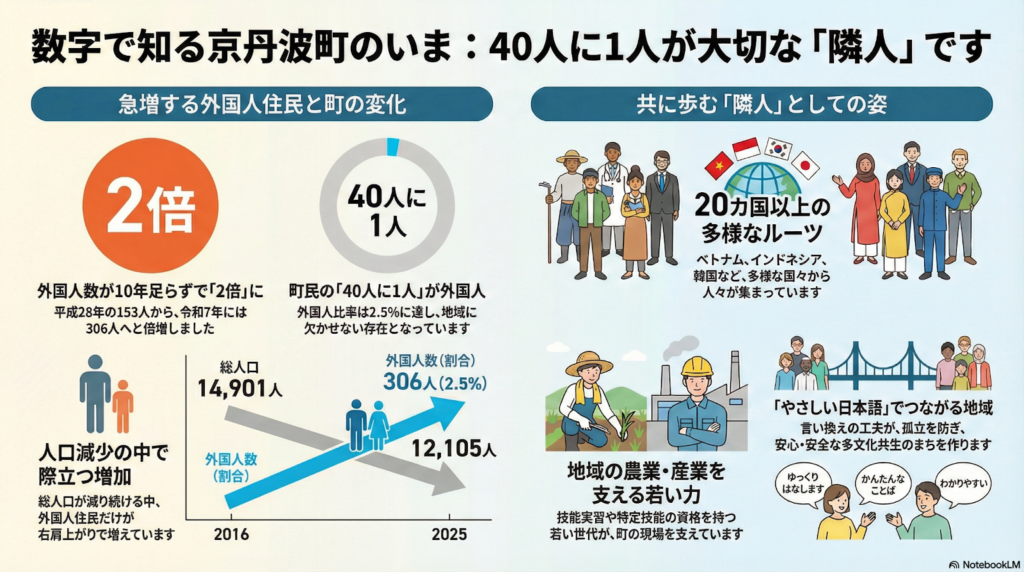
In Kyotanba Town, which has a total population of 12,105, there were 306 residents of foreign origin as of December 2025. This means that approximately one in every 40 residents is of foreign origin.
Among these 306 people, the largest group is Vietnamese, followed by Indonesians and Koreans. Most are technical interns or residents under the Specified Skilled Worker Program. They can be considered the future of Kyotanba Town’s agriculture and industry.
Kyotamba International Exchange Association works to connect our neighbors with international roots with local Japanese residents. Our goal is to build a town where everyone can live with peace of mind. Through Japanese language support, daily life information, and cultural exchange events, we bring the concept of "multicultural coexistence" closer to home.
By looking at each other not just as strangers, but as fellow residents, we can dissolve misunderstandings and anxieties. We are dedicated to creating spaces where people can meet naturally and find a helping hand whenever they need it.
Multicultural coexistence is not a "special" activity; it is simply an extension of our daily lives. As a bridge that supports that first step, Kyotamba International Association will continue to walk side-by-side with our community.
Kyotamba International Exchange Association Official Website
Summary
Multicultural coexistence isn't just for a select few; it’s a journey that involves everyone in our community. In an era of an aging population and increasing diversity, understanding and supporting one another is essential for our shared future.
It all starts with "learning" and "reaching out." Whether it’s using "Plain Japanese," joining local activities, or helping someone find the information they need—these small steps lead to a great sense of security for everyone. This isn’t a difficult task; it’s simply an extension of our daily lives. Your individual efforts, no matter how small, will help transform our town into a more welcoming place for all.
関連記事
-
What Is a Japanese Language Class? An Introduction to What Is Learned and How to Participate as a Volunteer
This article explains what Japanese language classes are, what participants learn, the role of Japanese language support volunteers and how to get involved, as well as the Japanese language classes offered by the Kyotamba International Exchange Association.
-
What Can You Do for Multicultural Coexistence? Practical Local Examples
How can you support multicultural coexistence? Discover simple, practical steps you can take today—from greeting your neighbors and using "Easy Japanese" to joining local community activities. We also highlight specific initiatives in Kyotamba Town.
-

Introducing 10 Case Studies of Multicultural Coexistence Initiatives
Discover 10 real-world examples of multicultural coexistence, from language support and disaster preparedness to healthcare and local exchange. Also introduces initiatives in Kyotamba, Kyoto.

Click here for our other SNS
-
Facebook

-
X

-
LINE

-
Youtube